
Why are so many financial services institutions investing in agentic AI, yet so few are seeing a real return on that investment?
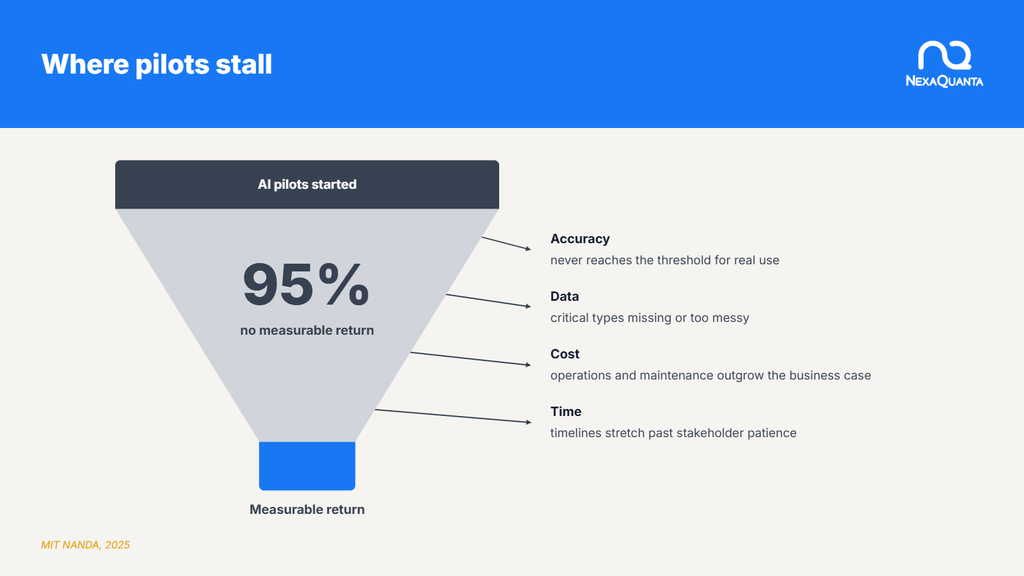
I answered this question in my talk at Ox Tech Week, at the AI Innovation and Entrepreneurship Forum hosted by Jesus College, Oxford, on why so many AI projects fail. MIT’s NANDA initiative found that 95% of generative AI pilots deliver no measurable return [1]. Since then, I have had the same conversation with banks, insurers, audit firms, and mortgage networks many times over. The appetite is there and so are the pilots. What is usually missing is a clear route from experimentation to production, and from production to a return the board can actually see.
At NexaQuanta, we have spent the last few years taking AI into production for regulated financial services clients, from a Tier 1 bank to compliance teams at regulated firms. Here are the six steps that, in my experience, take an AI initiative from pilot to payback.
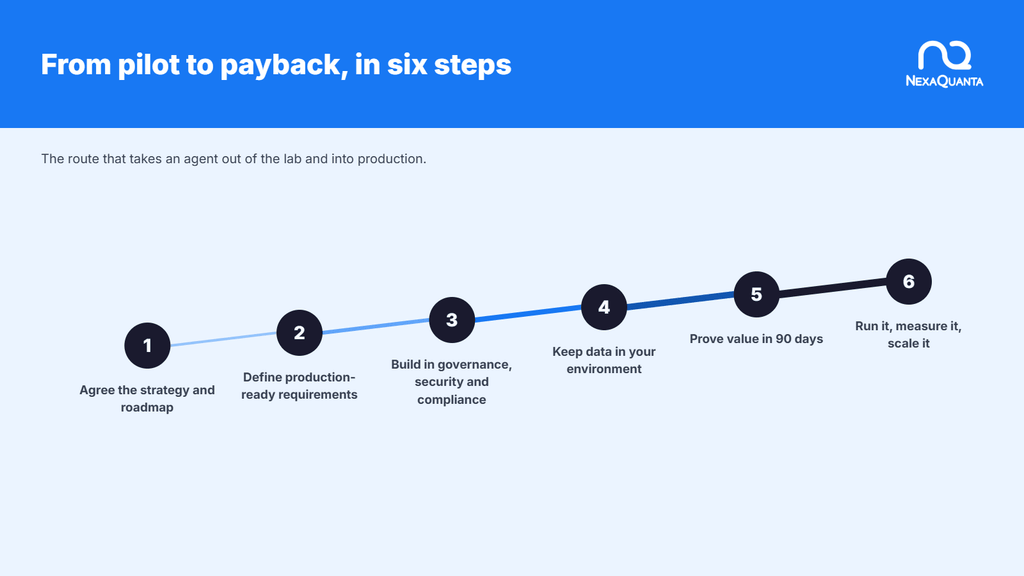
1. Start at the top: agree an AI strategy and roadmap
The biggest factor that separates success from failure is not the model or the platform. It is leadership. When an AI strategy and roadmap are agreed at the top, pilots are not built in a vacuum. They are built with a destination in mind.
That roadmap should answer a simple question: where will AI pay off first? In financial services, the best candidates are usually high-volume, rules-heavy processes that still need human judgement, such as KYC reviews, compliance checks, audit validation, and adviser support. These are the workflows where backlogs build up, costs grow with every new customer, and mistakes are expensive. My colleague David Moore covers five of the strongest candidates in his post on the best agentic AI use cases for financial services.
Pick one. Get it right, prove the value, and use it to build confidence for the next one.
2. Define production-ready requirements before you write a single line of pilot code
In my experience, most AI projects stall before production for one of four reasons:
- Accuracy. The model never reaches the threshold needed for real-world use.
- Data. Critical data types are left out, or the data is too messy to process reliably.
- Cost. Operational and maintenance costs grow beyond what the business will sustain.
- Time. Timelines stretch so far that stakeholders lose confidence before go-live.
Pilots and proofs of concept are a valuable starting point. The ones that scale have one thing in common: the team defined what “production-ready” means up front, and mapped the risks across all four dimensions from day one.
This is also the moment to set your baseline. Measure turnaround time, cost per case, error and rework rates, escalation volumes, and the size of the backlog. Without these numbers, you cannot prove ROI to your board.
Be honest in the business case, too. Boards often approve the economics of full automation, then find the organisation running a slower, human-supervised version with a smaller return. Decide early which steps the agent will own and where your people stay in the loop, and build the numbers on that.
3. Build governance, security and compliance in from day one
We firmly believe that AI innovation without security and governance is not innovation at all. In financial services, this is critical. An agent that cannot clear a compliance review never goes live, and an agent that never goes live delivers no return.
So bring your compliance, risk, and security teams in at the start, not a week before go-live. Agree on clear boundaries for every agent:
- Which decisions it can make on its own.
- Which data and systems it can access.
- What evidence it must keep.
- Which exceptions must go to a person for approval.
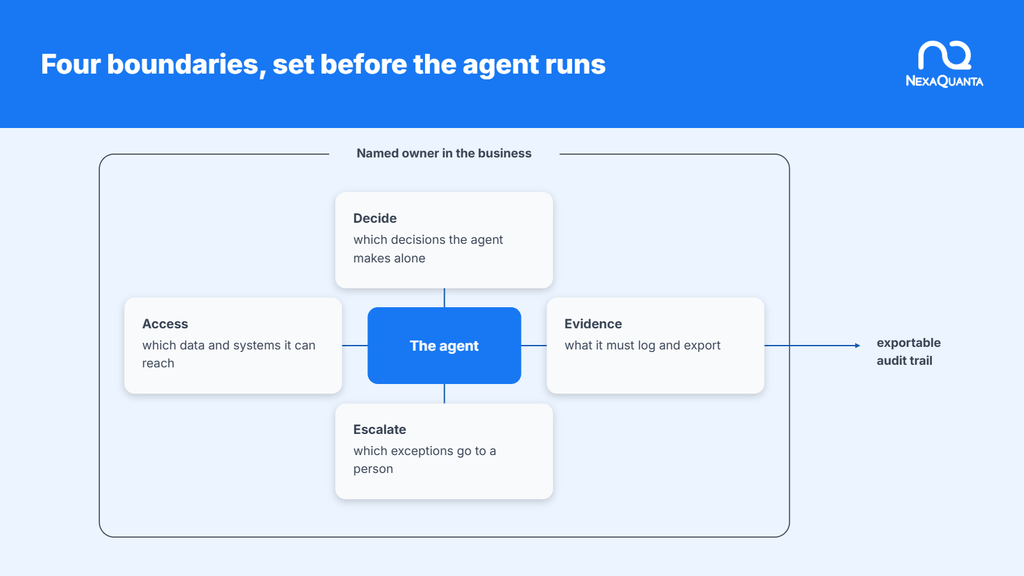
Every decision and reasoning step should be logged and exportable, so you are ready when the FCA [3] or another regulator asks, and when obligations under the EU AI Act [4] apply. Every agent should have a named owner in your business. And every outcome should be traceable and reversible, so that if a customer challenges a decision, you always have the final word.
Security matters just as much. As agentic AI becomes embedded in core workflows, risks such as prompt injection, data leakage, and insecure output handling are no longer optional considerations. They are foundational. This is why every member of the NexaQuanta development team has completed OWASP Top 10 training, including the OWASP Top 10 for Large Language Models [2].
Human-in-the-loop is not a cost to engineer away. It is what makes scale safe. The agent takes on the volume, and your experts focus on the judgement calls.
4. Keep your data in your environment and stay free of lock-in
Two objections come up in almost every conversation we have with financial institutions. “Our data can’t leave our environment.” And “We’re not signing anything that locks us into one AI vendor or one model.” Both are right, and both have a direct impact on ROI.
When AI agents are deployed inside your own AWS or Azure environment, your CISO signs off on the architecture, not on a vendor’s privacy policy. Security reviews move faster, procurement moves faster, and one of the most common blockers simply goes away. Data sovereignty should be an architecture decision, not a policy promise.
Lock-in is a quieter threat to ROI. AI models are improving, and prices change every few months. If your agents are built on open standards such as LangGraph, MCP, and A2A, and can run on Claude, GPT, Gemini, or open-source models, you can switch to a better or cheaper model without starting again. Your investment is protected.
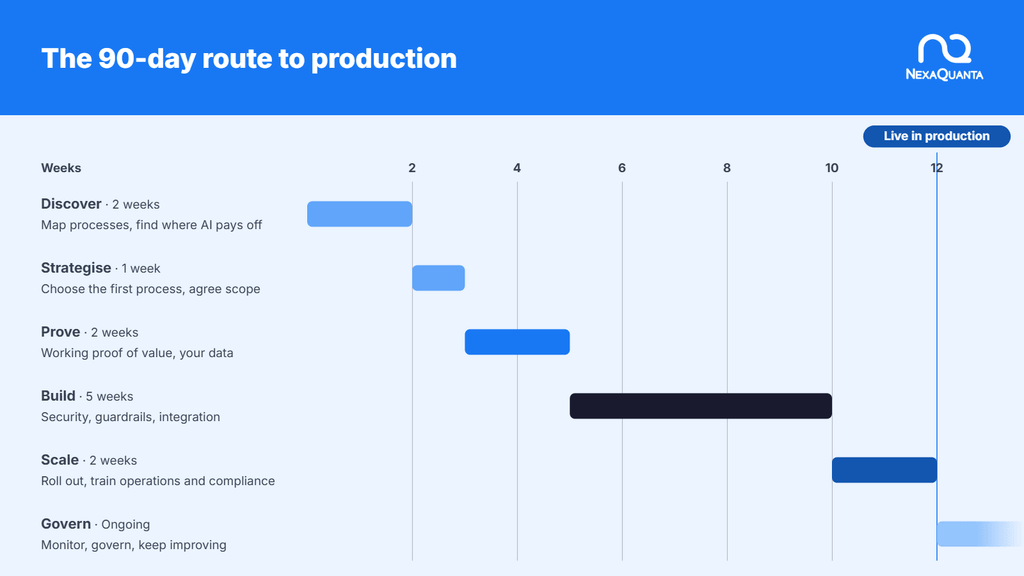
5. Prove value in production within 90 days
Long timelines kill AI projects. Every month without a result makes it harder to keep your stakeholders on board. Our aim with every client is to have the first process live in production within 90 days, not stuck in an endless implementation phase.
This is how we structure it:
- Discover (2 weeks). Map your processes and your technology, and find where AI pays off first.
- Strategise (1 week). Choose the first process and agree the scope and success criteria.
- Prove (2 weeks). Build a working proof of value in your environment, with your data. Not a vendor demo.
- Build (5 weeks). Do the production engineering: security, error handling, guardrails, and integration with your existing systems.
- Scale (2 weeks). Roll out to production and train your operations and compliance teams.
- Govern (ongoing). Monitor, govern, and keep improving the agents.
Then measure what matters. Compare against the baseline you set in step 2: turnaround time, cost per case, and error rates. Usage numbers and the number of prompts sent are not ROI.
6. Run it, measure it, then scale it
Go-live is not the finish line. ROI from AI agents builds over time, but only when they are actively managed. Agents that are monitored, retrained, and tuned get better and cheaper the longer they run. A pilot that is left alone and checked “once a quarter” slowly drifts, and so does its return.
That means treating agents as a managed operation:
- continuous monitoring and governance
- clear service levels for uptime and performance
- monthly reporting and quarterly reviews with the business
- model updates and retraining as your processes change
Once the first process is delivering, reuse what you have built. Connectors, guardrails, and governance set up for one process carry over to the next, so the second and third processes cost less and go live faster. This is where a pilot truly turns into payback, and the return starts to compound.
What agentic AI deployment for financial services looks like in practice
These steps come from real deployments. Here are a few results from our financial services clients:
| Client | What we automated | What we achieved |
|---|---|---|
| Large bank | Cross-document agentic compliance review of mortgage applications, with 200+ disclosure checks per case | Three months of manual review now takes minutes, with 100% audit-ready output and 40% faster approvals with no extra headcount |
| Global tier-1 bank | The full KYC review cycle with AI agents, from intake to sign-off, with people handling the exceptions | 50% faster KYC, and a months-long backlog cleared with no new hires |
| Leading audit firm | Agentic-enabled validation of financial statements across audit engagements | 80% less manual effort, so auditors can focus on judgement-led review |
| Leading mortgage broker network | An AI assistant in Microsoft Teams that searches products, lender criteria, and compliance rules | Advisers get answers in one conversation instead of several lookups and a call to a specialist |
In the first case, the compliance team that used to block AI deployment now runs on it. For me, that says more about ROI than any single number.
Final thoughts
Agentic AI is moving from experimentation to real business transformation in financial services. The institutions that get from pilot to payback will not necessarily be the ones that run the most pilots. They will be the ones that:
- start with a clear strategy and roadmap agreed at the top
- define production-ready requirements from day one
- build in governance, security, and compliance by design
- keep control of their data and their choice of model
- get to production quickly, and keep managing what they have built
If you are leading AI initiatives in financial services and want to lay the right foundations, we can help wherever you are on your journey. That might be an AI Readiness Assessment of your data, security, and compliance set-up, an AI Discovery & Roadmap workshop to find your quick wins, or a live demo of AI agents running a real compliance workflow.
References
- MIT NANDA, The GenAI Divide: State of AI in Business 2025, as reported in Fortune, “MIT report: 95% of generative AI pilots at companies are failing“, 18 August 2025.
- OWASP Gen AI Security Project, OWASP Top 10 for LLM Applications 2025.
- Financial Conduct Authority, AI Update, 2024.
- European Union, Regulation (EU) 2024/1689 (the Artificial Intelligence Act), 13 June 2024.
- David Moore, 5 Best Agentic AI Use Cases for Financial Services, NexaQuanta, 7 October 2026.
- NexaQuanta, Agentic AI Deployment Case Studies.
