
Agentic AI is moving beyond isolated task automation in financial services. Its strongest near-term applications are processes that combine high transaction volumes, fragmented data, judgement-based decisions and costly manual hand-offs: from credit assessment and customer onboarding to fraud investigation, claims handling and regulatory change management.
In my previous role at an RPA vendor, I worked with financial services customers to automate discrete, high-value tasks. RPA proved its worth in many of the scenarios below. Agentic AI goes further: digital workers can plan, reason across systems and act within clear guardrails, while handing decisions to people whenever human judgement is required.
In this post, I’ll explore the five agentic AI use cases delivering value across banking, insurance and compliance in financial firms: what each involves, why it matters, and what the published evidence says about the benefits you can expect.
These five use cases stand out because they combine measurable economic value with processes that are sufficiently structured for automation but still require judgement, exception handling and human accountability. They also have published evidence of impact, rather than relying only on theoretical potential.
What makes AI “agentic”?
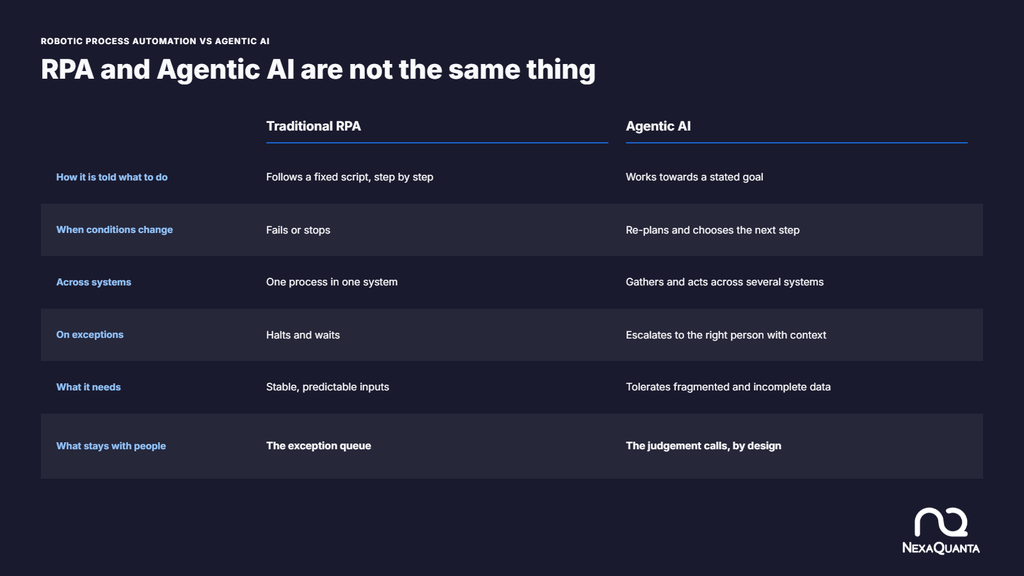
Traditional RPA automation follows a fixed script and may fail when it encounters error situations. An AI agent works towards a goal: it gathers information, decides what to do next, coordinates across systems and escalates exceptions to the right person.
1. Loan Origination and Automated Underwriting
The short answer: agentic AI can reduce credit decision times from days to minutes for suitable applications, while helping institutions apply approved risk criteria more consistently and route exceptions to human underwriters.
Net interest margin remains the primary revenue engine for most retail banks, and mortgages and loans are among their largest long-term revenue streams. Yet credit assessment is often slow, labour-intensive and inconsistent from one underwriter to the next.
How a digital worker helps
- Collects application data and supporting documents, chasing anything missing
- Pulls in alternative data to build a fuller picture of risk
- Assesses each application against the bank’s credit policy in real time
- Routes complex or exceptional cases to specialist underwriters
The payoff
Faster decisions, lower processing costs, consistent risk decisions and the capacity to scale during demand peaks. Customers get a smoother experience, and underwriters get their time back for the cases that truly need them.
What the evidence says
- Credit is document-heavy and data-hungry, so the gains show up first in analyst time and turnaround:
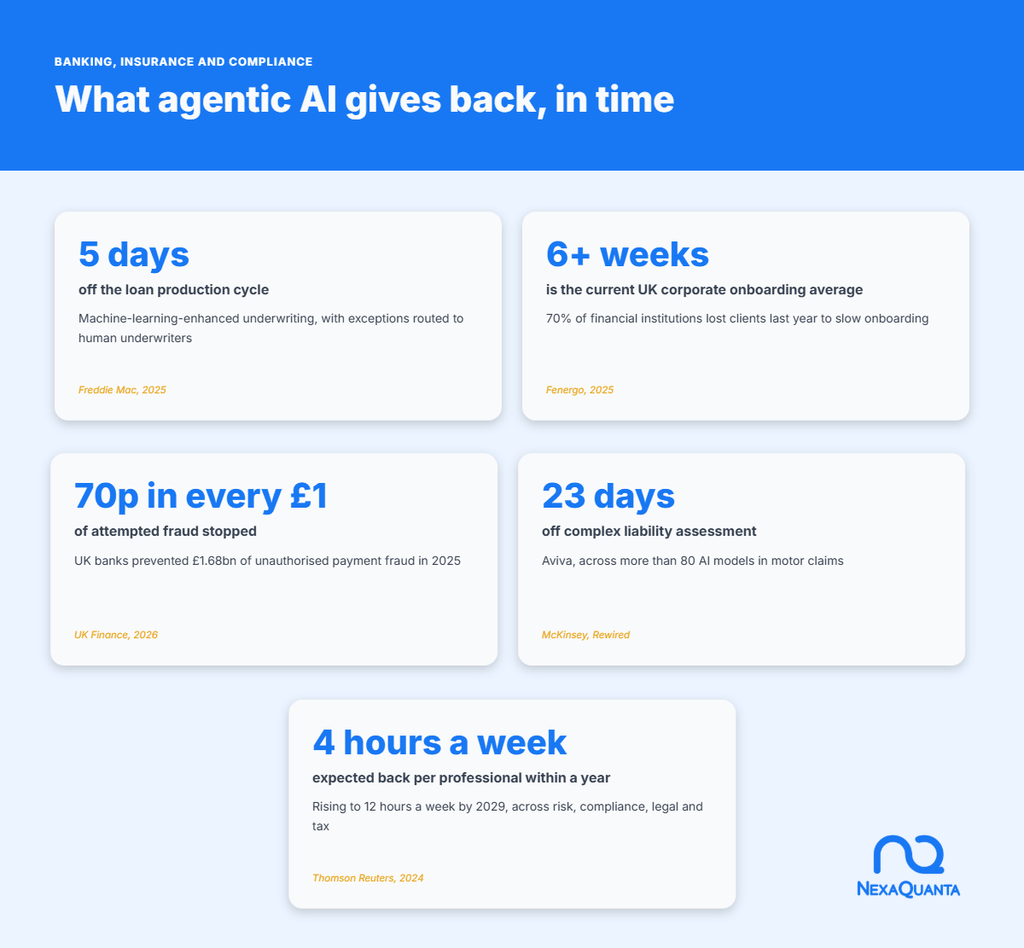
- Freddie Mac says its machine-learning-enhanced underwriting can save mortgage lenders up to $1,500 per loan (around 14% of processing cost) and shorten the average loan production cycle by about five days.[2]
- At one retail bank, AI agents that pull data from ten or more sources and draft credit-risk memos delivered a 20–60% productivity increase and a 30% improvement in credit turnaround, with relationship managers moving from drafting to oversight.[1]
2. Customer Onboarding and KYC/AML Compliance
The short answer: onboarding is a customer’s first impression, and agentic AI makes it fast without cutting compliance corners.
A slow, paper-heavy process leads to high abandonment rates. At the other end of the scale, onboarding a family office or sovereign wealth fund with layered ownership structures can take weeks.
How a digital worker helps
- Verifies identity documents, biometrics and e-signatures so retail customers can open an account from a smartphone in under five minutes
- Runs KYC, AML and sanctions screening in the background
- Unwraps complex ownership structures, from trusts to offshore entities, and supports source-of-wealth checks
- Flags missing information and heightened risk early
The payoff
Faster account opening, lower compliance costs, more consistent and auditable checks, and less identity fraud. Compliance teams can focus on higher-risk cases and enhanced due diligence.
What the evidence says
- The case for change is as much commercial as regulatory, because slow onboarding costs clients as well as money:
- 70% of financial institutions lost clients in the past year because of slow or inefficient onboarding, and UK corporate banks take more than six weeks on average to onboard a client.[3]
- The average firm spends US$72.9 million a year on KYC/AML operations, rising to US$78.4 million in the UK.[3]
- Banks can devote up to 10–15% of their full-time staff to KYC/AML. Separately, McKinsey estimates that a model in which one practitioner supervises 20 or more AI agents could produce productivity gains ranging from 200% to 2,000%.[4]
3. Fraud Detection and Risk Management
The short answer: agentic AI does not just flag anomalies; it can investigate them and coordinate a proportionate response in real time.
Fraud prevention is a constant, high-stakes battle. Banks must stop theft without adding friction for legitimate customers, while insurers must catch bad actors without delaying genuine payouts.
How a digital worker helps
- Uses behavioural analytics, such as how a customer types, holds their phone or navigates an app, to verify identity quietly in the background
- Monitors transactions in real time and declines fraudulent payments before the money leaves the bank
- Spots insurance red flags such as inconsistent statements, inflated claims or a policy bought days before a loss
- Cross-references external data and documents to build the evidence
The payoff
Earlier detection, fewer financial losses and fewer false positives that frustrate genuine customers. Decisions become more consistent and auditable, and investigators can concentrate on organised fraud and emerging threats.
What the evidence says
- Losses are large, and major payment networks show what AI-driven detection can achieve at scale. These examples demonstrate the value of machine learning and generative AI in fraud prevention; agentic systems can extend that capability by coordinating investigation, evidence gathering and response across multiple tools.
- Criminals stole £1.28 billion from UK customers in 2025, while banks stopped £1.68 billion of unauthorised payment fraud, equal to 70p in every £1 attempted.[5]
- Visa reports that AI helped it block 80 million fraudulent transactions worth about $40 billion in 2023.[6]
- Mastercard’s initial modelling for its generative AI fraud model showed detection rates up 20% on average (and up to 300% in some cases), with false positives cut by more than 85%.[7]
4. Insurance Claims: From First Notice to Settlement
The short answer: claims are an insurer’s largest expense and its defining “moment of truth”, and agentic AI speeds up the whole journey.
The first notice of loss (FNOL) sets the pace for everything that follows. Efficient handling lowers Loss Adjustment Expenses and keeps customers loyal.
How a digital worker helps
- Captures loss details consistently across apps, web portals, chatbots and call centres, requesting missing photos or evidence
- Triages each claim by severity, complexity and fraud indicators
- Uses straight-through processing to validate cover and pay simple claims, like a cracked windscreen, with no manual hand-offs
- Values damage using parts pricing, repair estimates and depreciation data
The payoff
Faster and more consistent decisions, more accurate payouts and the ability to absorb claims surges after a major storm. Claims specialists can give complex or sensitive cases the attention they deserve.
What the evidence says
- Insurers that have automated the claims journey report gains in speed, cost and customer sentiment:
- Aviva deployed more than 80 AI models across motor claims, cutting the time to assess liability on complex cases by 23 days, improving routing accuracy by 30% and reducing customer complaints by 65%.[8]
- Lemonade says 55% of its claims are automated, and its cost per pet insurance claim fell from $65 in 2020 to $19.[9]
5. Regulatory Horizon Scanning and Control Mapping
The short answer: agentic AI keeps institutions ahead of regulatory change, turning new rules into mapped obligations and assigned actions in days, not months.
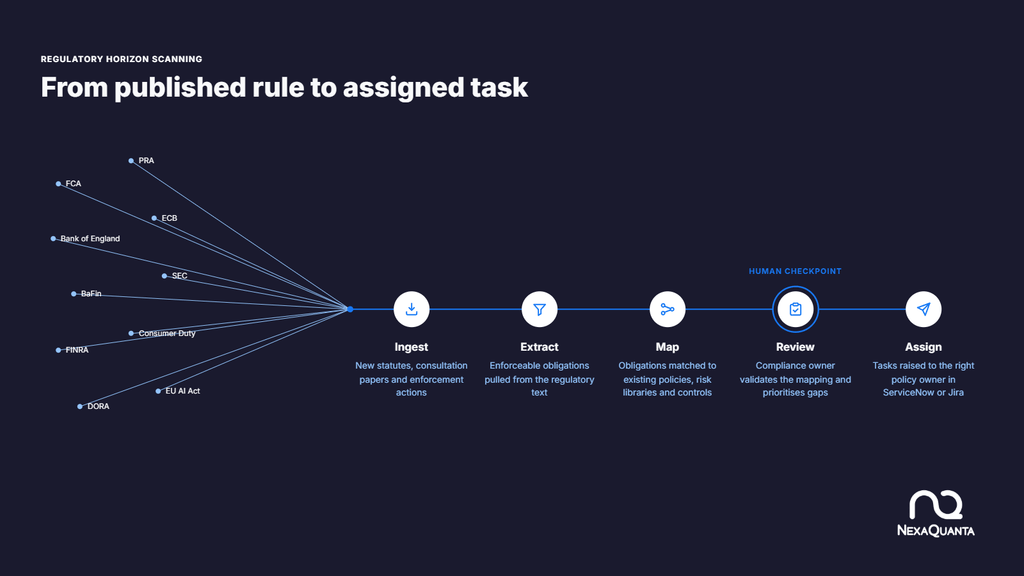
Legal and compliance teams manually monitor dozens of regulatory portals and guidance notes, from the FCA, PRA, ECB, BaFIN, SEC, FINRA, Consumer Duty, DORA, the EU AI Act, SS1/23.
Analysts must read every update, decide whether it applies, and cross-reference it against internal policies and controls held in spreadsheets to find compliance gaps. Notably, we helped one client reduce three months of manual review down to minutes, ensure the reviews were 100% audit-ready, deployed on their private Azure environment with no data leaving the client’s environment.
How a digital worker helps
- Continuously pulls newly published statutes, consultation papers and enforcement actions into a central regulatory repository
- Reads the regulatory text and extracts the enforceable obligations
- Maps each obligation against existing policies, risk libraries and operational controls
- Highlights gaps, estimates operational impact and creates tasks for the right policy owners in tools such as ServiceNow or Jira
The payoff
Fewer missed regulatory updates, policy implementation lead times reduced from months to days, and an auditable lineage connecting external law to internal risk controls. Compliance teams can spend more time interpreting the rules and validating their application, rather than searching for them.
What the evidence says
- The pressure here is volume: no team can read everything by hand, and time spent hunting is time not spent interpreting.
- Firms faced an average of 220 regulatory change alerts every day in Thomson Reuters’ ten-year review of the regulatory landscape, and volumes have not eased since.[10]
- Risk, compliance, legal and tax professionals expect AI to save them four hours a week within a year and 12 hours a week by 2029. Thomson Reuters likens the first figure to adding an extra colleague for every ten team members.[11]
Best Agentic AI Use Cases in Financial Services At a Glance
| Use case | Where it applies | Headline benefit | Human oversight |
|---|---|---|---|
| Loan origination and underwriting | Retail and commercial banking | Credit decisions in minutes instead of days | Human underwriters approve exceptions, verify affordability and review borderline credit decisions. |
| Onboarding and KYC/AML | Banking, wealth management | Faster onboarding, lower compliance cost | Compliance teams review high-risk customers, ownership complexity and sanctions or AML alerts. |
| Fraud detection and risk | Banking, insurance | Fewer losses and fewer false positives | Fraud specialists validate escalations, tune risk rules and approve customer-impacting interventions. |
| Claims, from FNOL to settlement | Insurance | Lower LAE and faster payouts | Claims handlers oversee complex, sensitive or disputed claims and confirm payout recommendations. |
| Regulatory horizon scanning and control mapping | All sectors | Policy updates in days, not months | Compliance owners validate obligation mapping, prioritise gaps and approve policy or control changes. |
Conclusion
My blog highlights that one pattern runs through all five use cases. Agentic AI absorbs the volume and the coordination, so specialists keep the judgement calls.
Across all five use cases, the safest deployment pattern is bounded autonomy: define which decisions an agent may take, which data and systems it may access, what evidence it must retain, and which exceptions require human approval. Institutions should test accuracy, bias, resilience and auditability before expanding the agent’s authority.
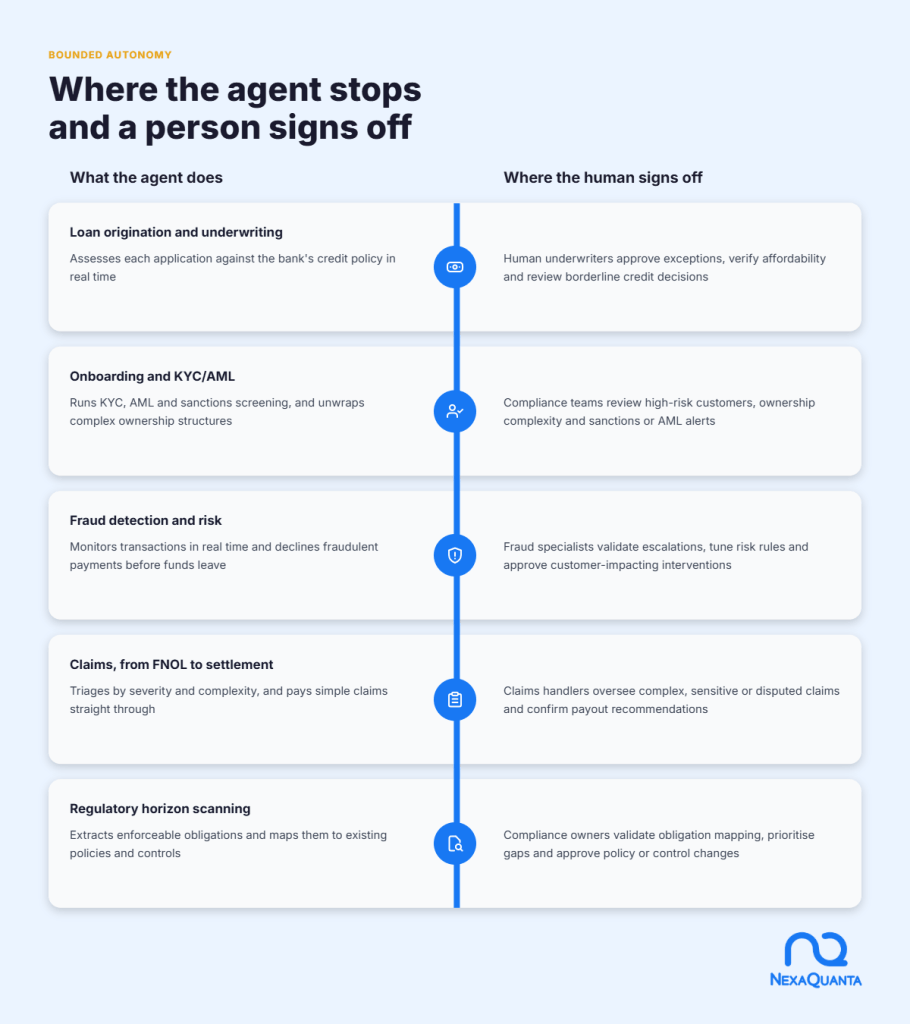
Success still depends on getting the foundations right: good-quality data, human oversight built in, and decisions that are explainable and auditable for regulators.
Your next step: Choose one high-volume process, map it end to end, and identify where hand-offs, rework and delays create the greatest cost or customer friction. Establish a baseline for turnaround time, cost per case, error rates and escalation volumes, then use those measures to judge whether a digital workforce could make a meaningful impact.
Automate your heaviest workflows in 90 days with agentic AI. Secure, auditable & deployed in your cloud.
Sources
Figures are as published by the organisations cited and are indicative rather than guaranteed. Several are vendor-reported or based on initial modelling, so results will vary with each institution’s data, processes and starting point.
[1] McKinsey & Company, “Seizing the agentic AI advantage” (QuantumBlack, 2025)
[2] Mortgage Professional America, “Freddie Mac unveils AI underwriting update to cut loan costs” (May 2025)
[3] Fenergo, 2025 Financial Crime Industry Trends report, press release (October 2025)
[4] McKinsey & Company, “How agentic AI can change the way banks fight financial crime” (August 2025)
[5] UK Finance, Annual Fraud Report 2026 (June 2026)
[6] PYMNTS, “Visa: AI helped block 80 million fraudulent transactions in 2023” (July 2024)
[7] Mastercard, “Mastercard supercharges consumer protection with gen AI” (February 2024)
[8] McKinsey & Company, “Aviva: Rewiring the insurance claims journey with AI” (Rewired in action case study)
[9] Claims Journal, “Lemonade embraced AI in claims from inception, and is still eyeing the next tech” (March 2025)
[10] Thomson Reuters Regulatory Intelligence, Cost of Compliance 2019, as reported by CTMfile
[11] Thomson Reuters, Future of Professionals report, press release (July 2024)
