
Your employees can already name the agentic AI use cases sitting in your operations. Nobody has asked them in a structured way. Five categories of question, drawn from an employee assessment survey, give a COO or Head of Operations a practical route from operational experience to an evidence-based inventory of automation opportunities.
Nine in ten organisations now use AI regularly, but a 2026 McKinsey study found only 37 per cent report it has contributed positively to their bottom line.¹ The gap sits in knowing where to focus effort and allocate budget. Here are the five themes and questions that our guide on agentic AI use case discovery for financial services will discuss:
- The time thief: repetitive, manual work
- The data bridge: information frictions between systems
- The bottleneck: where work slows down
- The experience: where customer and staff experience suffers
- The AI wish: what employees would change
- Where these five questions fit: from survey to roadmap
Each question carries its own qualification test and a worked example from UK banking, insurance or wealth management. The survey takes about 20 minutes per respondent.
The Time Thief: “What is the most repetitive, manual job you do every week?”
Ask employees to name the tasks that consume disproportionate time relative to the judgement they require: reconciliation preparation, evidence collation, management information, complaint triage or retrieval of control procedures.
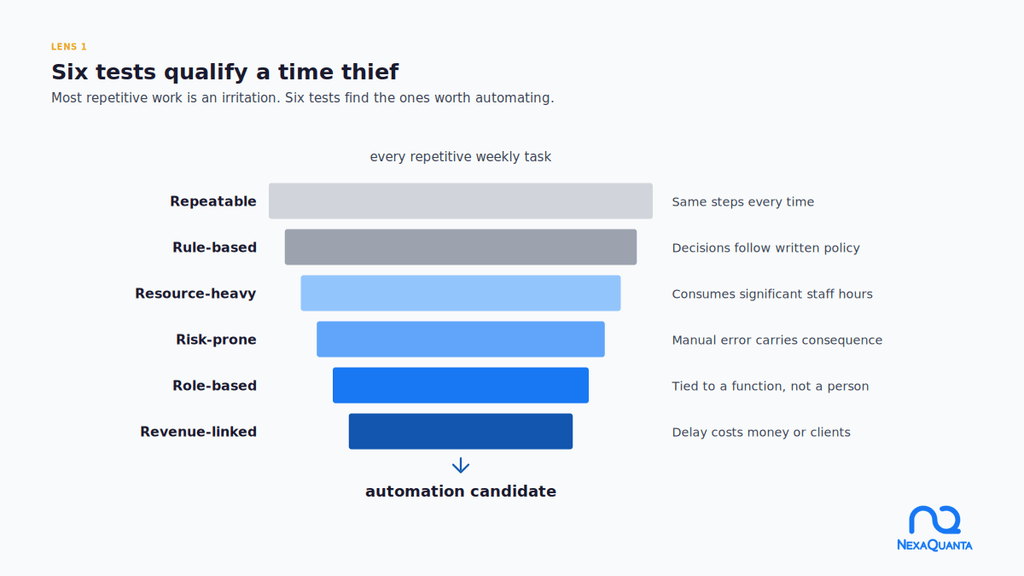
To distinguish an irritation from a genuine opportunity, apply ‘The 6Rs of Time Thief Discovery’ framework:
- Repeatable: do the same steps occur regularly?
- Rule-based: does it follow policies or an established procedure?
- Resource-heavy: does it consume considerable time, data-handling effort or document review?
- Risk-prone: does manual handling create material potential for error?
- Role-based: is it common to a recognised function?
- Revenue-linked: would improving it support income, capacity or commercially material outcomes?
Why ask this question
This creates a baseline against which later outcomes can be measured. Alongside the tests, respondents should estimate frequency, effort per occurrence, number of people involved, frustration level, error exposure and consequence of delay. Not every repetitive task is worth automating. The six tests help a senior executive separate genuine transformation candidates from minor annoyances.
BFSI example: month-end reconciliation
A Ledge survey of 100 finance professionals found that cash reconciliation alone consumes 20 to 50 hours per month, with most teams using three to five systems. Half take six or more business days to close the month, and 94 per cent still rely on Excel.² My conversations with financial control functions at investment banks paint a similar picture: staff apply adjustments to millions of line items, each backed by precedence or criteria, creating a heavy month-end reporting burden.
An agent could pull data from source systems, match transactions, flag exceptions for human review and produce working papers. The finance team reviews exceptions and signs off, rather than rebuilding the close manually. NexaQuanta built this pattern for a global tier-1 bank’s corporate and investment banking division, automating KYC document identification, extraction and review end to end across more than 40 document sources, for a 20 per cent productivity gain.
The Data Bridge: “Where do you manually transfer or re-key the same information between systems?”
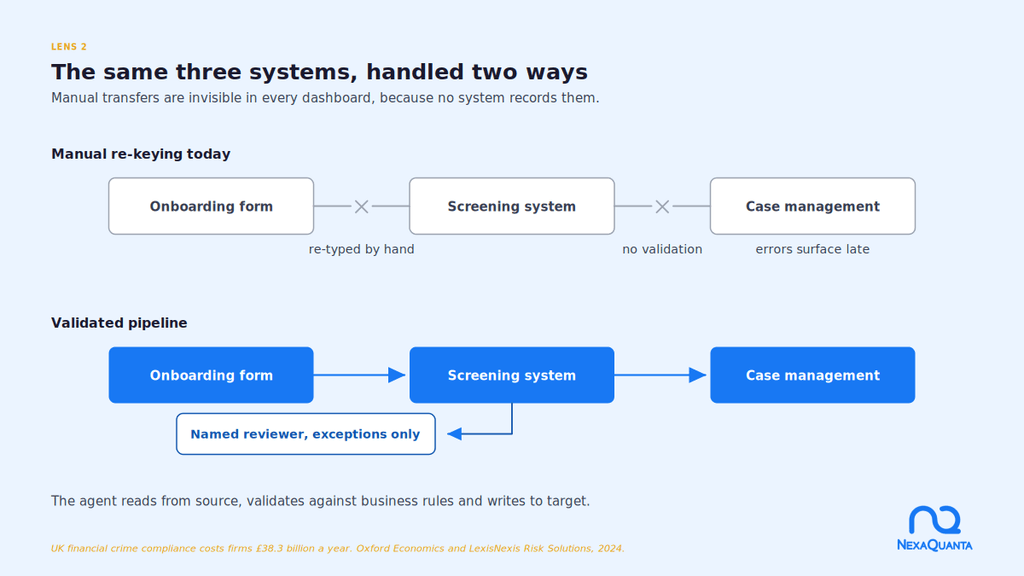
Every financial services firm has processes where the same information moves between platforms by hand. A compliance analyst re-keys client details from an onboarding form into a screening system, then into a case management tool. A claims handler enters the same loss details into a policy system and a separate reserving platform. Each transfer introduces delay, error and compliance exposure: in regulated firms, an inaccurate entry can trigger a control failure.
Why ask this question
Data bridges are invisible to leadership because they are embedded in how work has always been done. Asking the question surfaces these hand-offs and makes the cost visible.
An agent maintaining a persistent connection between systems would read from the source, validate against business rules and write to the target, flagging discrepancies for human review. The human checkpoint moves from performing the transfer to reviewing exceptions.
BFSI example: the cost of financial crime compliance
Oxford Economics research with LexisNexis Risk Solutions (254 senior UK compliance executives, 2024) found that UK firms spend an estimated GBP 38.3 billion per year on financial crime compliance, with costs rising roughly 33 per cent since 2021. Labour ranks highest in compliance spending.³ A separate LexisNexis EMEA study (Forrester Consulting, 1,181 respondents, 2023) found screening alerts rising at 78 per cent of EMEA organisations as payment volumes increased, with 72 per cent reporting rising staff costs.⁴ 98 per cent of UK firms have implemented or plan to adopt AI in financial crime screening by 2026.³
The Bottleneck: “What is always waiting on one person or one approval?”
Bottlenecks in financial services operations arise from several distinct sources:
- Work waiting for approvals or sign-offs
- Dependence on one person or team who cannot keep pace with volume
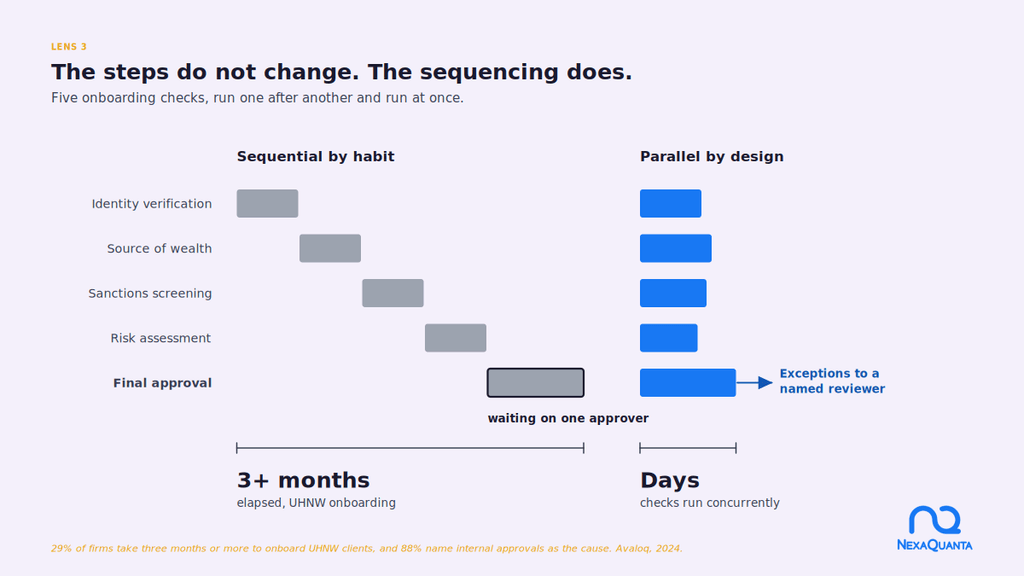
- Tasks forced into sequence when they could run in parallel
- Staff lacking access to systems or tools they need to proceed
- Too many manual steps, each adding elapsed time without adding judgement
Why ask this question
Bottlenecks are not always people problems. A sequential approval chain that could be parallelised is a process design problem. Asking employees where work slows down, without presupposing the cause, surfaces the full range of constraints.
An agent can triage incoming requests against policy rules, routing only genuine exceptions to a human reviewer, and initiate parallel workflows where the current process forces them into sequence. The human stays in the loop for decisions requiring judgement.
BFSI example: wealth management onboarding delays
An Avaloq survey of 200 UK and European wealth managers (2024) found that 29 per cent said onboarding ultra-high net worth clients takes three months or more. Internal approval processes were flagged as a pain point by 88 per cent of UK respondents, and manual intervention by 70 per cent.⁵
An agent could check document completeness, flag missing information, route independent checks in parallel and escalate stalled cases. Reviewers retain responsibility for compliance decisions and final approval.
The Experience: “Where do customers chase you, or staff wait for an answer?”
Ask employees to identify where the experience breaks down: a client calls to ask what is happening, an adviser waits days for a response from operations, teams duplicate work for lack of visibility, onboarding takes far longer than it should, or reporting requires manual assembly that delays decisions.
Why ask this question
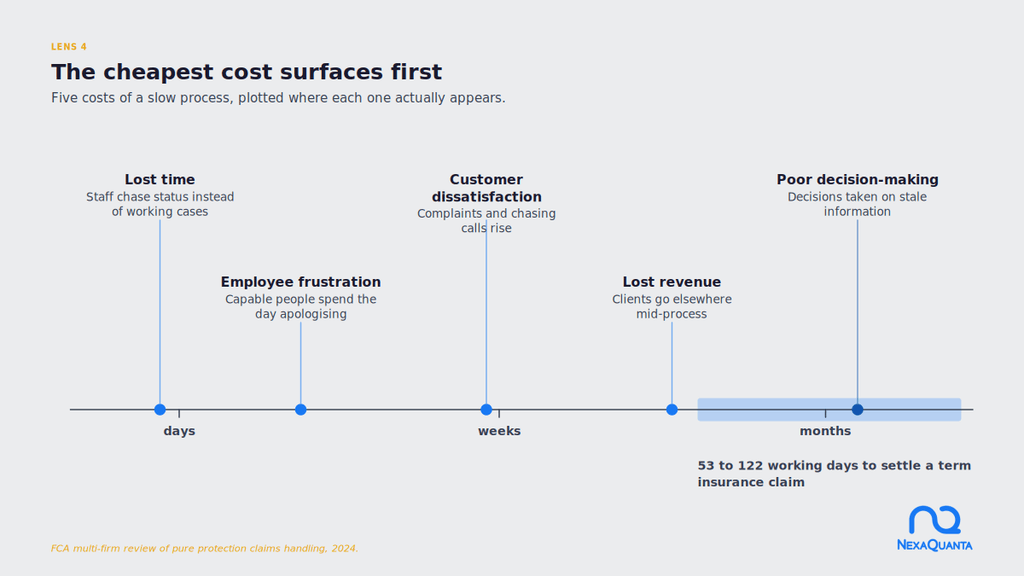
Experience failures are often symptoms of upstream bottlenecks and data bridges, but they carry distinct costs that compound on different timescales:
- Lost time: immediate and measurable
- Lost revenue: builds as delays compound across transactions and clients
- Customer dissatisfaction: accumulates over weeks, surfacing as complaints or attrition
- Employee frustration: drives turnover and disengagement
- Poor decision-making: caused by slow or incomplete reporting, may not surface for months
Under the FCA’s Consumer Duty, unexplained delay is a form of foreseeable harm. This question gives leadership a direct line to the service failures that matter most.
BFSI example: insurance claims delays
The FCA’s multi-firm review of pure protection insurance claims handling (2024) found processing times for term insurance claims ranged from 53 to 122 working days, with poor communication a recurring theme.⁶ Which? analysis of Financial Ombudsman Service data (year to June 2024) found upheld complaints against life insurers rose from 40 to 51 per cent, with unfair delay cited in 38 per cent of cases.⁷
Under Consumer Duty, these are potential regulatory findings. An agent could track elapsed time against targets, send proactive updates to claimants, flag cases approaching thresholds for human review and escalate stalled cases. The assessor makes the decision; the agent ensures the claimant is never left wondering.
The AI Wish: “If one task could be taken off your plate completely, what would you want it to do?”
This question is deliberately open-ended. The previous four lenses ask employees to identify specific patterns. The AI Wish asks them to name the thing they most want solved, in their own words.
Why ask this question
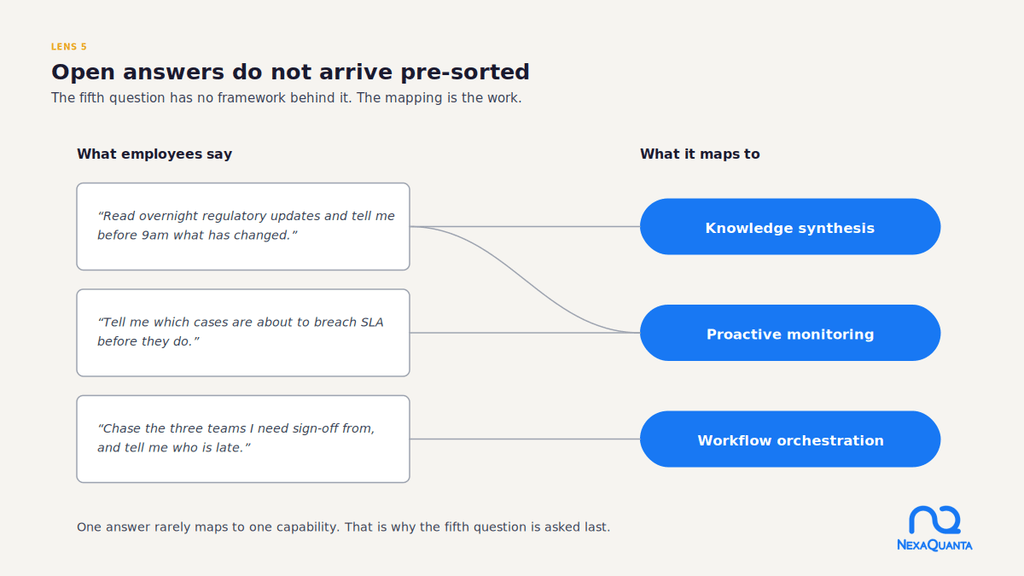
Structured questions surface structured answers: that is their strength and their limitation. The AI Wish might surface something the first four miss: “I want an agent that reads overnight regulatory updates, cross-references them against our policies and tells me before 9am what has changed.” That is a knowledge synthesis task. These responses often point to opportunities where the value shows up as capacity for higher-order work.
The responses also function as a cultural signal. If every answer is about spreadsheets, the organisation’s understanding of agents may be narrow. If answers include workflow orchestration or proactive monitoring, more advanced use cases may be closer than expected. McKinsey’s Rewired argues leaders should ask people what they would build if accepted constraints were removed: the wish-list often surfaces opportunities top-down analysis misses.
For the types of use cases that should feature on these wish lists, see best agentic AI use cases for financial services. The value of this lens is in the asking, so the answers are the examples.
Where these five questions fit: from survey to roadmap
These five categories of questions are a starting point. A short employee survey based on them produces a raw inventory of tasks, hand-offs and pain points. That inventory is one of several pathways into a broader AI discovery process.
| Lens | What you ask | What an agent does | Where the human signs off |
|---|---|---|---|
| Time thief | The most repetitive manual job you do each week | Pulls from source systems, matches transactions, flags exceptions | Finance reviews exceptions and sign offs the close |
| Data bridge | Where you re-key the same information between systems | Reads from source, validates against rules, writes to target | Reviewer handles flagged discrepancies |
| Bottleneck | What is always waiting on one person or approval | Triages against policy, runs checks in parallel, escalates stalled cases | Reviewer retains client decisions |
| Experience | Where customers chase you or staff wait | Tracks elapsed time, sends updates, flags cases near thresholds | Assessor makes the claim decision |
| AI wish | What you would take off your plate completely | Varies by response | Named owner defined at scoping |
Three pathways to AI discovery
1. A short employee survey.
The five-question framework surfaces task-level opportunities employees see every day. It is a low-effort entry point deployable in days.
2. AI productivity tool usage data.
If the organisation has deployed CoPilot, Claude or another tool, usage patterns show where employees already find value and where they stop.
3. A comprehensive AI Discovery Workshop.
This facilitated engagement brings business, technology and risk stakeholders together to map workflows and assess opportunities. Each candidate is evaluated for value, agent suitability, feasibility, data readiness and governance. Only those with a named owner, measurable outcome and acceptable risk profile progress to the prioritised portfolio.
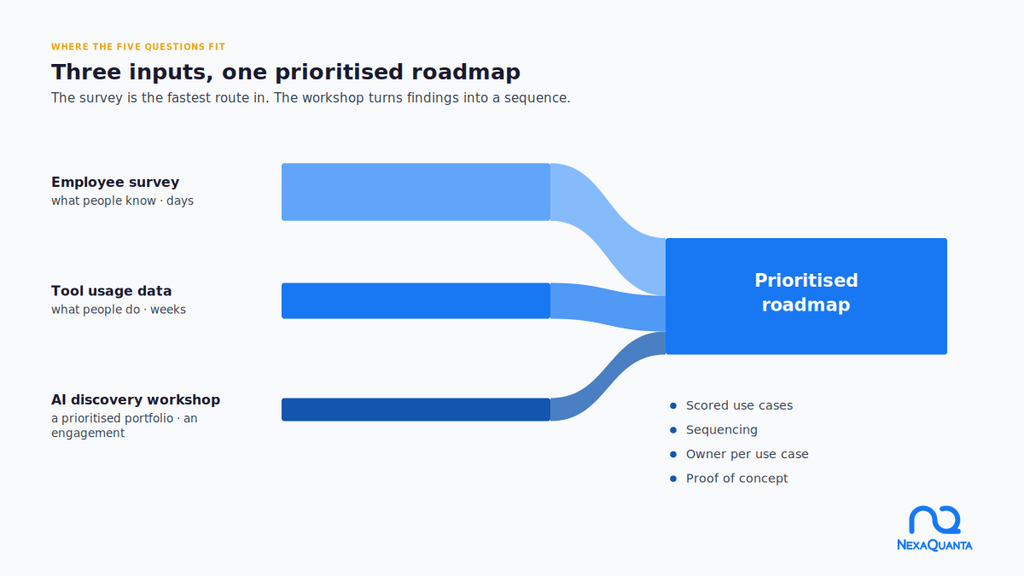
Each pathway addresses a different blind spot: the survey captures what employees know, usage data shows what they do, and the workshop produces a prioritised portfolio. Together, they move an organisation from anecdote to evidence. For the commercial framework that follows, see steps to maximise agentic AI ROI in financial services.
Starting with the right questions
Twenty minutes from each respondent and a willingness to listen produce an evidence base a COO can defend in a budget conversation. Combined with usage data and a facilitated workshop, these questions move an organisation from experimentation to a prioritised roadmap. Start with one high-volume process and establish a baseline before automating anything. Book a 30-minute discovery conversation to work out which process to put through this first.
Frequently asked questions
Who should run the five-question survey?
The survey should be sponsored by a COO or equivalent senior leader with authority across functions. It should be administered to employees who perform the day-to-day work. The value comes from hearing from the people closest to the processes, not from technology teams alone.
How many employees need to respond for useful results?
There is no fixed threshold, but a useful survey covers enough of the organisation to surface patterns rather than individual frustrations. For an enterprise-wide view, aim for representation across each major function. Quality of response matters more than volume: a detailed answer from one claims handler can be more valuable than a one-word answer from fifty.
What happens after the survey?
The survey produces a raw inventory of tasks, hand-offs, bottlenecks and pain points. An AI discovery workshop then validates those findings against enterprise objectives, scores each use case for agentic fit and return on investment, and produces a prioritised portfolio ready for a proof of concept.
How does this relate to an AI readiness assessment?
An AI readiness assessment evaluates whether an organisation is prepared to adopt AI, reviewing data quality, security posture, infrastructure, skills and governance. The five-question survey answers a different question: where should AI be applied? Firms that have not yet assessed readiness should do so before committing to larger investments.
What is the difference between an AI agent and an agentic workflow?
An AI agent is a single system that performs a bounded set of actions: updating a record, routing a case or screening a transaction. An agentic workflow orchestrates several agents or steps across an end-to-end process, managing sequencing, state and exception handling across systems and teams. Our Agentic Work solutions deliver both.
How long does agentic AI take to deploy in financial services?
Timelines vary by complexity and regulatory requirements. A typical engagement runs from initial discovery (two weeks) through strategy and proof of concept (three weeks) to build and deployment (five weeks), with ongoing governance thereafter. The critical variable is the governance, testing and change management that regulated firms require.
Sources
¹ McKinsey & Company, “The state of AI in 2026: On the road to ROI,” August 2026. https://www.mckinsey.com/capabilities/quantumblack/our-insights/the-state-of-ai#/
² Ledge, “Month-end close benchmarks for 2025,” April 2025. https://www.ledge.co/content/month-end-close-benchmarks-for-2025
³ Oxford Economics / LexisNexis Risk Solutions, “True Cost of Financial Crime Compliance Study: UK Edition,” July 2024 (254 senior UK compliance executives). https://risk.lexisnexis.co.uk/insights-resources/white-paper/true-costs-of-compliance
⁴ A FORRESTER CONSULTING THOUGHT LEADERSHIP PAPER COMMISSIONED BY LEXISNEXIS® RISK SOLUTIONS, SEPTEMBER 2023. EMEA True Cost of Financial Crime Compliance Study.
⁵ Avaloq / IBS Intelligence, “Wealth management onboarding survey,” July 2024 (200 UK and European wealth managers).
⁶ FCA, “Multi-firm review of pure protection insurance claims handling,” 2024.
⁷ Which?, analysis of Financial Ombudsman Service data on life and protection insurance complaints (year to June 2024).
